

About Us
Party Building Work


The Data Science programme combines computer science, mathematics and statistics to provide a strong interdisciplinary foundation. Building on Zhejiang University of Technology’s strengths, it balances theory and practice to develop high-level, versatile professionals and future industry leaders. Graduates gain expertise in data processing, analysis and prediction, along with an innovative mindset, global vision and cross-cultural collaboration skills, enabling them to solve complex challenges in the big data field.
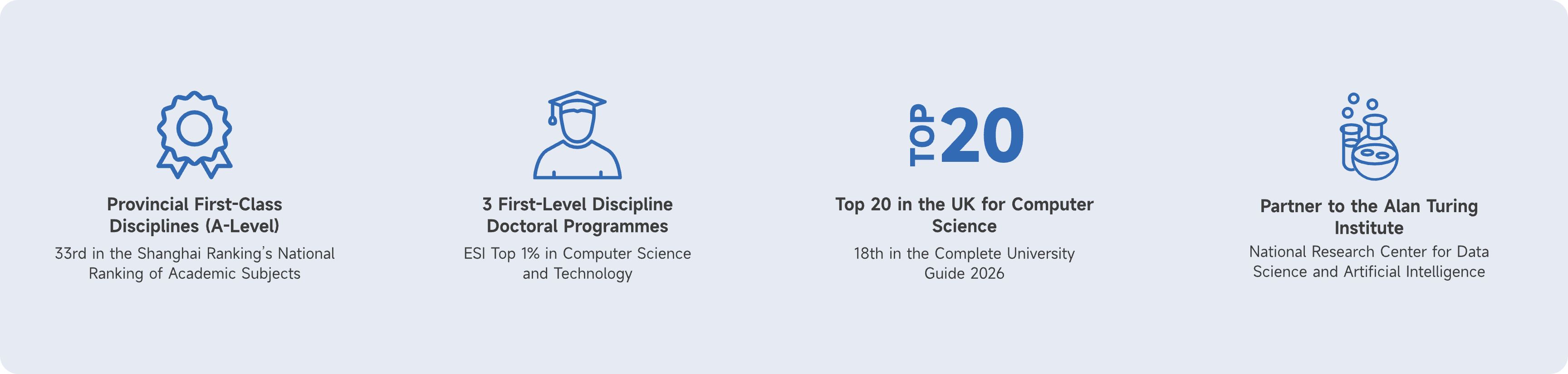
The programme draws on ZJUT’s two provincial first-class disciplines - Computer Science and Technology and Software Engineering - and three first-level doctoral programmes in Computer Science and Mathematics. It follows a dual-focus approach of “Engineering Application + Analysis” and ranks among the top provincial universities in overall strength. Nearly all professional courses use original international textbooks. Through close collaboration with the University of Exeter’s Data Science programme, ranked in the UK top 10 for Computer Science research impact and recognised for world-leading AI projects, students benefit from an international curriculum and access to cutting-edge academic perspectives.
Supported Disciplines: Computer Science and Technology, Mathematics

Statistical Modelling and Inference, Fundamentals of Machine Learning, Computers and the Internet, Data Structures and Algorithms, Calculus, Discrete Mathematics and Probability, Programming, Probability, Statistics and Data, Social and Professional Issues of Information Age, Communication & Climate Crisis, Software Development, Statistical Inference: Theory and Practice, Group Software Engineering Project, Machine Learning and Data Science, Data Science at Scale, Database Theory and Design, Social Networks and Text Analysis, Machine Learning and AI, Bayesian Data Modelling, Final Project
The programme offers students access to the University of Exeter’s advanced facilities, including high-performance computing clusters and data visualization laboratories. Through the Data Science Centre and its collaborations with organisations such as the UK Met Office and the National Health Service (NHS), students can take part in cutting-edge research projects in areas like climate modelling and healthcare big data, developing a global perspective and international research skills.
Students also benefit from partnerships with more than 80 leading industry enterprises, including Huawei, Alibaba, NetEase, Hikvision and Nokia. Initiatives include co-building the Huawei “Intelligent Foundation,” the Ministry of Education–Alibaba Cloud Collaborative Education practice base, and on-campus simulated enterprises with Nokia and ArcSoft. These collaborations provide tailored courses and position-specific training, creating seamless integration between industry, academia and research.
Domestic Further Study:
1.Access to Zhejiang University of Technology's policy for recommending outstanding undergraduates for exemption from entrance examinations for postgraduate programmes.
2.Participation in the National Postgraduate Entrance Examination.
3.Application for master's degree programmes within the college.
Overseas Further Study:
1.Application to world-renowned universities such as the University of Oxford and the University of Cambridge.
2.Admission to corresponding master's programmes at the University of Exeter through its Undergraduate-to-Master's Pathway Programme, with eligibility for tuition fee reduction policies.
Employment:
Graduates of the Data Science programme have wide-ranging career opportunities across multiple sectors. They can work as data analysts or algorithm engineers in internet technology companies, focusing on data mining and business optimisation, or engage in quantitative analysis and risk control modelling within fintech institutions, supporting financial digitalisation. Graduates may also contribute to industrial big data analysis and production process optimisation in smart manufacturing enterprises, driving intelligent transformation, or take on data-driven roles in digital positions across industries such as retail, healthcare and government, applying their professional expertise to support intelligent decision-making.
The programme equips students to become dynamic problem solvers with strong technical skills. The broad-based knowledge and abilities developed during the degree provide an excellent foundation not only for careers directly related to data science but also for a wide range of roles in other fields.