


About Us
Party Building Work


Energy and Environmental Engineering is an interdisciplinary major designed to support China's carbon peaking and carbon neutrality goals and the development of new, efficient energy systems. The programme responds to the energy transition and transformation in the digital era, integrating energy science, environmental engineering, power engineering to prepare the next generation of engineering professionals.
Drawing on the university’s leading disciplines, the programme places equal emphasis on strong theoretical foundations and practical engineering skills. It aims to develop international, high level and versatile graduates with broad subject knowledge, solid technical expertise, cross disciplinary innovation capability and strong global competence, ready to contribute to sustainable energy development and environmental protection.
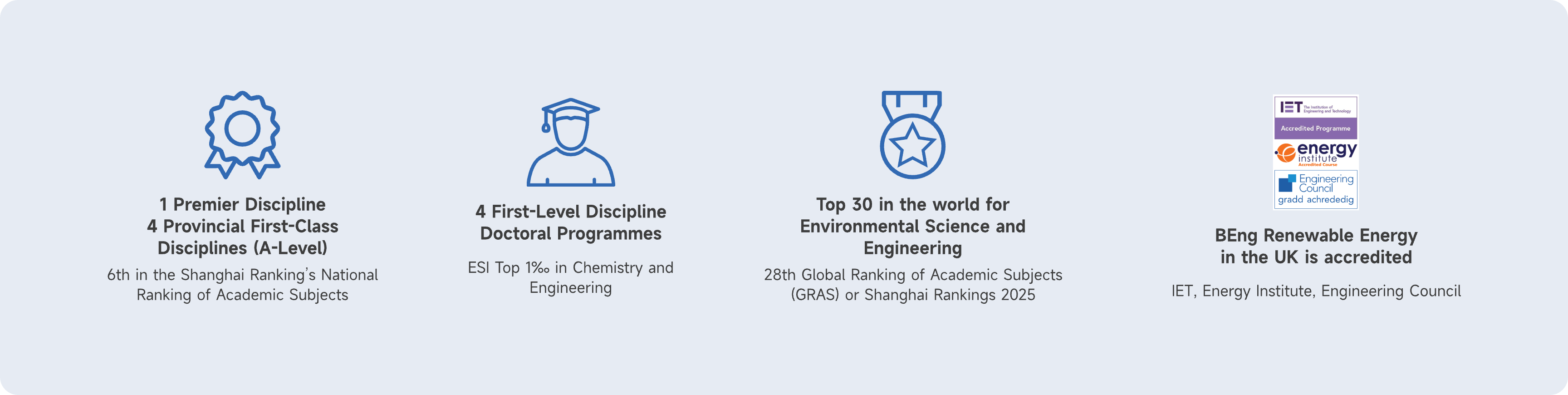
This programme is supported by Zhejiang University of Technology’s leading discipline, Chemical Engineering and Technology, ranked 8th nationally, together with three Zhejiang Provincial Class A First-Class Disciplines: Power Engineering and Engineering Thermophysics, ranked 43rd nationally, Environmental Science and Engineering, ranked 27th nationally, and Materials Science and Engineering. It also integrates high quality academic resources from the University of Exeter in the UK. Exeter’s energy discipline was the first in Europe and second globally to offer a Renewable Energy major, and its Environmental Science and Engineering is ranked among the global top 40. A related programme in Renewable Energy Engineering at Exeter holds triple accreditation. This strong partnership and established record of international education provide students with global perspectives and access to advanced academic expertise.
Supported Disciplines: Chemical Engineering and Technology, Power Engineering and Engineering Thermophysics, Environmental Science and Engineering and Materials Science and Engineering

Engineering Mathematics & Scientific Computing, Fundamental of Engineering, Fundamental of Mechanics, Fundamental of Electronics, Fundamental of Materials, Fundamentals of Chemistry, Brief introduction to Environmental Engineering, Renewable Energy Systems, Applied Computing for Energy Studies, Modelling of Engineering System, Fluids Mechanics, Applied Thermodynamics, Communication & Climate Crisis, Solar Power, Energy Storage Technology, Marine Renewable Energy, Wind Energy, Environment and Sustainable Technology, New Energy Materials, Industrial Innovation Practice, Industrial Project, Group Challenge Project, Final Project
This programme draws on the research strength of Zhejiang University of Technology, with disciplines ranked in the global top 0.1% in Chemistry and Engineering and in the global top 1% by ESI, supported by two State Key Laboratories. It also benefits from the academic expertise of the University of Exeter in the UK, including a Top 40 global ranking in Environmental Science by the Shanghai Ranking and its pioneering Renewable Energy discipline, which launched the second renewable energy programme in the world. Students are encouraged to take part in advanced research projects to develop international research skills and a global outlook.
The programme has established a comprehensive practical teaching system. It works with Baimahu Laboratory to build joint science and education bases, supporting major industrial clusters in energy and environmental protection, and collaborates with six local research institutes to contribute to industrial upgrading. Partnerships include Sinopec, Qinshan Nuclear Power and more than 30 platforms in Belt and Road countries such as Malaysia and Indonesia, promoting close industry university research collaboration. Practical training runs throughout the degree, from fundamental modules in the first year, to Engineering Innovation Week in the second year, and industry internships in the third year and a final project in the fourth year, strengthening engineering practice and complex problem-solving skills.
Domestic Further Study:
1. Access to Zhejiang University of Technology's policy for recommending outstanding undergraduates for exemption from entrance examinations for postgraduate programmes.
2. Participation in the National Postgraduate Entrance Examination.
3. Application for master's degree programmes within the college.
Overseas Further Study:
1. Application to world-renowned universities such as the University of Oxford and the University of Cambridge.
2. Admission to corresponding master's programmes at the University of Exeter through its Undergraduate-to-Master's Pathway Programme, with eligibility for tuition fee reduction policies.
Employment:
Our graduates are closely aligned with the high level technical and research and development needs of major industrial clusters in renewable energy, environmental protection and advanced equipment manufacturing. Their expertise directly supports national energy technology development strategies and responds to China's carbon peaking and carbon neutrality goals.
Graduates are equipped for exciting roles in renewable energy design, environmental consultancy, sustainable infrastructure and energy innovation. In this context, they are prepared to become high level and urgently needed professionals in interdisciplinary energy fields, with strong research and innovation capability and an international perspective. This programme empowers graduates to lead the green transition, locally and globally, with technical expertise and a commitment to sustainability at the heart of their careers. Career opportunities include large power generation groups and grid companies such as State Grid, power design institutes and research institutes, energy divisions of major state-owned enterprises such as Sinopec, as well as new energy companies and digital environmental governance enterprises.